# Karrot Community Spotlight
Kim interviewed Nick Sellen from Karrot
- lemme know any shoutouts or socials here or how you want to be named
- i also need at least 1 good landscape picture with alt text and credit to use as a featured image, ideally a photograph, if you have more even better
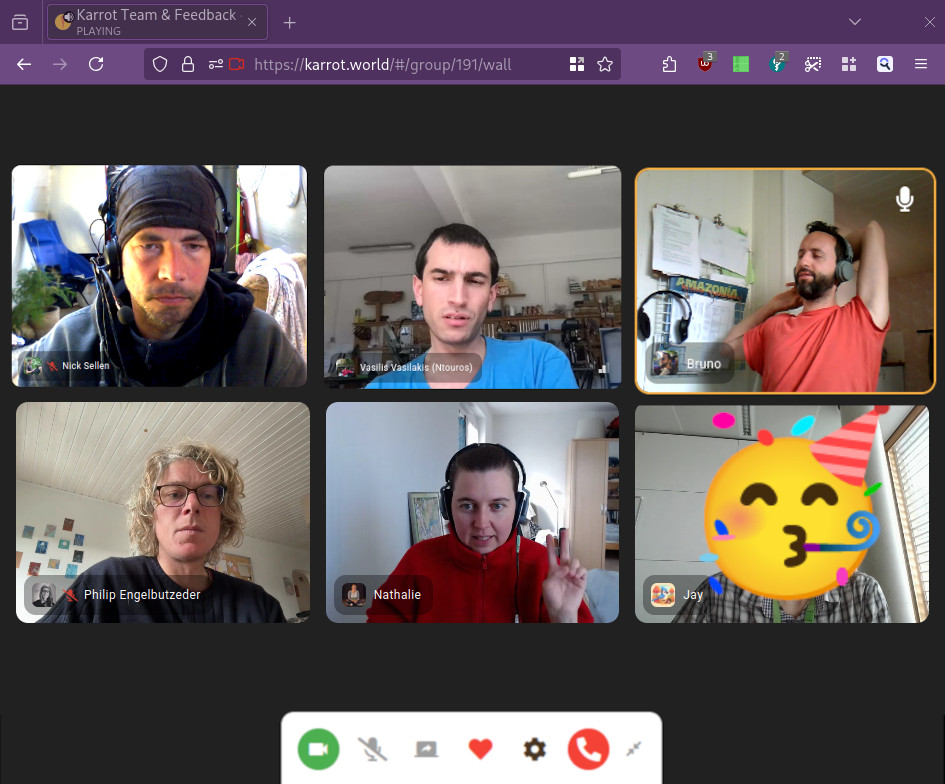
Caption: _Our team is distributed around Europe (UK, Germany, Sweden, Luxembourg, Greece), and we have never all been in one place other than on a video call!_
Alt: _Screenshot of an online Karrot meeting. There are 6 people in the call._
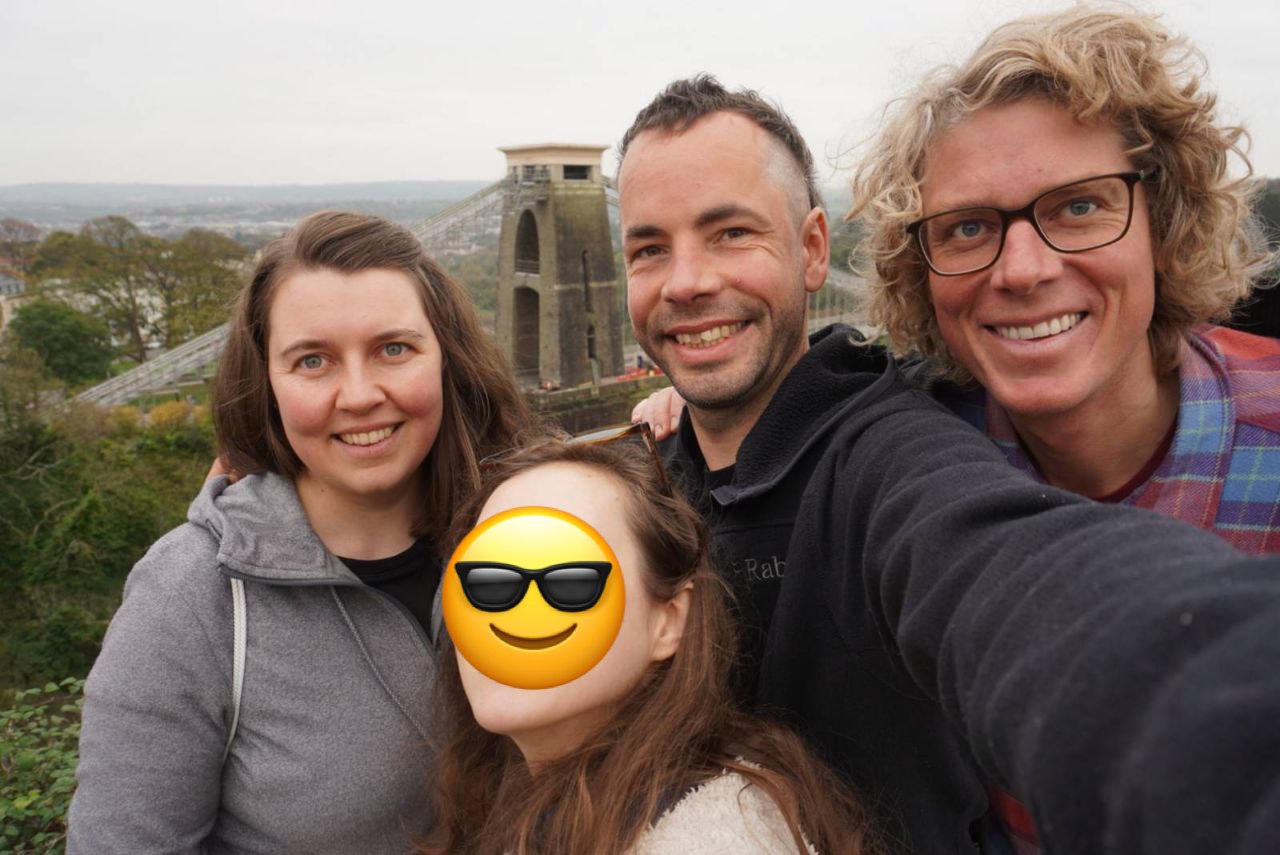
Caption: _We had some time walking around the sights of Bristol whilst over there_
Alt: _4 people gathering around to take a selfie infront of the Clifton suspension bridge in Bristol_
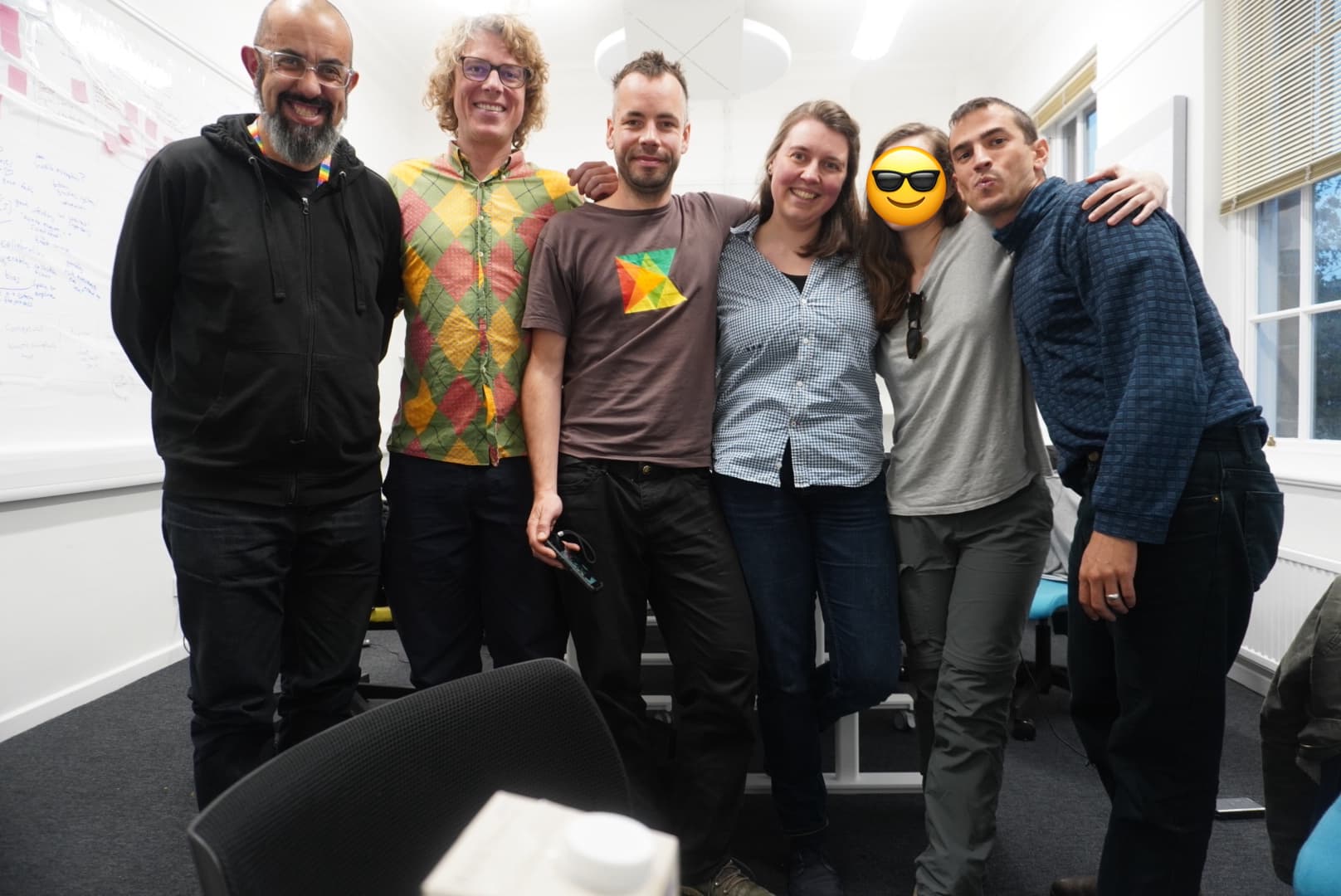
Caption: _Our time in Bristol as a team, although missing Bruno, but with the addition of Matt Dowse from the University of Bristol_
Alt: _5 people in a meeting room posing for a photo_
https://karrot.world/
## So tell me a bit about how Karrot came to be?
We emerged out of a dream to build a digital sharing platform for the world, building off the back of the success a great foodsharing platform for German-speaking regions (https://foodsharing.de). Here's the original invitation to the event https://www.youtube.com/watch?v=kTh24fueZNI - 10 years ago now!
The initial idea was a multipurpose sharing/reuse platform to prevent all sorts of resources from being wasted - including features for saving food, ride sharing, sharing tools, etc. All with no/minimal money.
We had an initial gathering in Italy (see writeup: https://yunity.org/en/heartbeat/wuppdays-begins) and from there had a few years of in person gatherings at various locations around Europe. The code we worked on back then is the start of Karrot!
Our initial focus was enabling groups that can't use foodsharing.de (due to language or governance reasons) to start groups to co-ordinate redistribution of surplus foods.
## What does Karrot do in the simplest terms?
You create a group on Karrot, and use it to co-ordinate! People can apply to your group and you can choose whether to accept them or not. This is your community! Karrot is a tool to support your community organising.
The focus is on groups that do in-person activities together - e.g. "we need 2 people every wednesday to collect food from this supermarket at 5pm" (doesn't need to be about food!). Once people have done an activity, they can give feedback about how it went. Over time you can see statistics for what your group is doing.
There are communication features to write messages to everyone in the group, or only those interested in specific aspects of the group, or only those signed up to do a specific activity.
We are aimed towards groups that want to self-organise - that is, to organise with less hierarchical structures - no admins! That means there are group processes for when a conflict arises, and we encourage groups to add their group agreements.
## Do you have any big success stories?
I think still existing 10 years later having been built and maintained with minimal money/funding is a big success in itself, in a world where many small platforms come and go. Our early adopters (when we had almost no features) are still using Karrot in very active daily use, and continue to work with us.
Each day approximately 3 tonnes of food are redistributed using Karrot.
We have found a rhythm of working where we can keep the platform alive, even if the funding runs out, and even if life pulls us in other directions for a while (seasonal phases of work). That feels like resilience to me.
I also am very proud that we are using almost entirely open source tools - including emails (postal), video calls (livekit) and all the tools to manage the work on the project itself (penpot, excalidraw, codeberg, etc..).
## In a world where everyone just uses WhatsApp, how do you pitch the value add that a platform like Karrot has?
Yes, good question. Even though I would rather people did not have to use a tool from Meta like WhatsApp, if that's the tool that has the people on and the group is getting started it can be the best tool for the job. I generally don't try and persuade people to use Karrot. I sometimes see it more like a "specialist business tool" - if they are struggling with the problems that Karrot solves, then they will feel the benefit of it!
WhatsApp also comes with its own set of problems that come up for community groups: personal and project messages/notifications are combined in one tool (good for some, bad for others), no/few features for more specific organising tasks, new users added to groups can't read the old messages, group governance features are not always good fit for self-organised groups.
Would a small business or charity try organise everything through WhatsApp groups? No! There are reasons that organisations use tools with specialized features, and that applies to community organising too at a certain scale.
For some groups it's nice to know they're using tools that reflect their values too.
## When we discussed it on Discord we noticed it's a lot more in use in Germany than the UK! Why do you think this is?
We emerged out of a Germany-based project, and most of our early groups were from personal connections of people in this wider network. Some groups using foodsharing.de also wanted to operate independently from the wider foodsharing.de project, and Karrot is a tool that enables them to do that whilst keeping a similar model of organising.
The interface has been available in multiple languages since the very start of the project, so this further supports groups across many European countries to use it.
Although I am from the UK, and now live here again, we had relatively few connections with UK projects, and these kind of projects often grow through the network of connections rather than marketing. I'm hoping the UK-usage can grow over time!
## Can you tell us a bit about the tech stack?
Yes! It's a "boring" tech stack, solid and dependable. It's built using Python with Django, and Django REST Framework. The database is PostgreSQL with a Redis instance alongside. The frontend is Vue using Quasar (provides many components and other features).
We try and keep it so not too many additional services are needed, optional video calls are enabled via Livekit (hosted or self-hosted), and collaborative pads are built using yjs and python libraries (avoiding extra nodejs service), websockets are handled in python too with asgi and django channels. Push notifications are handled using Web Push (so no third party service).
We use vite for frontend builds, and Codeberg CI for builds and releases. Deployment for our hosted instance is managed using ansible, and self-hosted configurations are supported using Co-op Cloud or Docker Compose.
## How can people get involved?
If you just want to play around with Karrot, you can sign up and use our Playground group: https://karrot.world/#/groupPreview/16 or you can create your own group here: https://karrot.world/#/group/create. Documentation is available at https://docs.karrot.world/.
If you want to interact with the team you're welcome to apply to this group: https://karrot.world/#/groupPreview/191 or via the community forum (https://community.karrot.world/). The code is over at https://codeberg.org/karrot/ (although better to introduce yourself first rather than jump in right away).
We have a How to get involved doc over at https://community.karrot.world/t/how-to-get-involved-onboarding-into-the-karrot-team/661 too :)
## How are you funded?
Most our existence we operated as a gift economy / volunteer project. We received 2 rounds of nlnet grant funding (see https://community.karrot.world/c/funding/28) totalling 46kEUR.
We have been wondering about developing a "Community Supported Software" approach for a while (https://community.karrot.world/t/design-process-on-community-supported-software-css/1667), and may explore that in the future.
## What's next on your roadmap?
We recently did a big strategy session, the outcomes of that are still emerging. We did find 5 aspects to develop: finances, how we work (team), supporting existing groups, reaching out to more groups, and our broader visions (of societal transformation).
We try to not build new tech features without that broader context.
I would like to work closely with new community organising groups/networks, and find out which adapations we could make to better support their organising. Sometimes it might be as simple as making sure the messaging makes sense to potential groups/users, or hiding features they don't need. We have had a lot of discussions about having an incremental approach, so new groups just have a simple messaging tool, and only add in features when the group really needs them.
Another recurring need is better support for groups to interact with people outside of their core members (whether through public event listings, public activity signups, newsletters, etc...) as community groups often consist of a wider circle of "followers" to engage with.
As we have a core spirit of self-organised working, it would be nice to support groups with skills, practises, resources and connections when trying to work in this way. Small groups often need a helping hand to get started with basic governance mechanisms (e.g. creating a clear group agreement at a certain size), and we may develop features to better support that evolution.